Bücher versandkostenfrei*100 Tage Rückgaberecht***Abholung in über 100 Filialen

Inhaltsverzeichnis
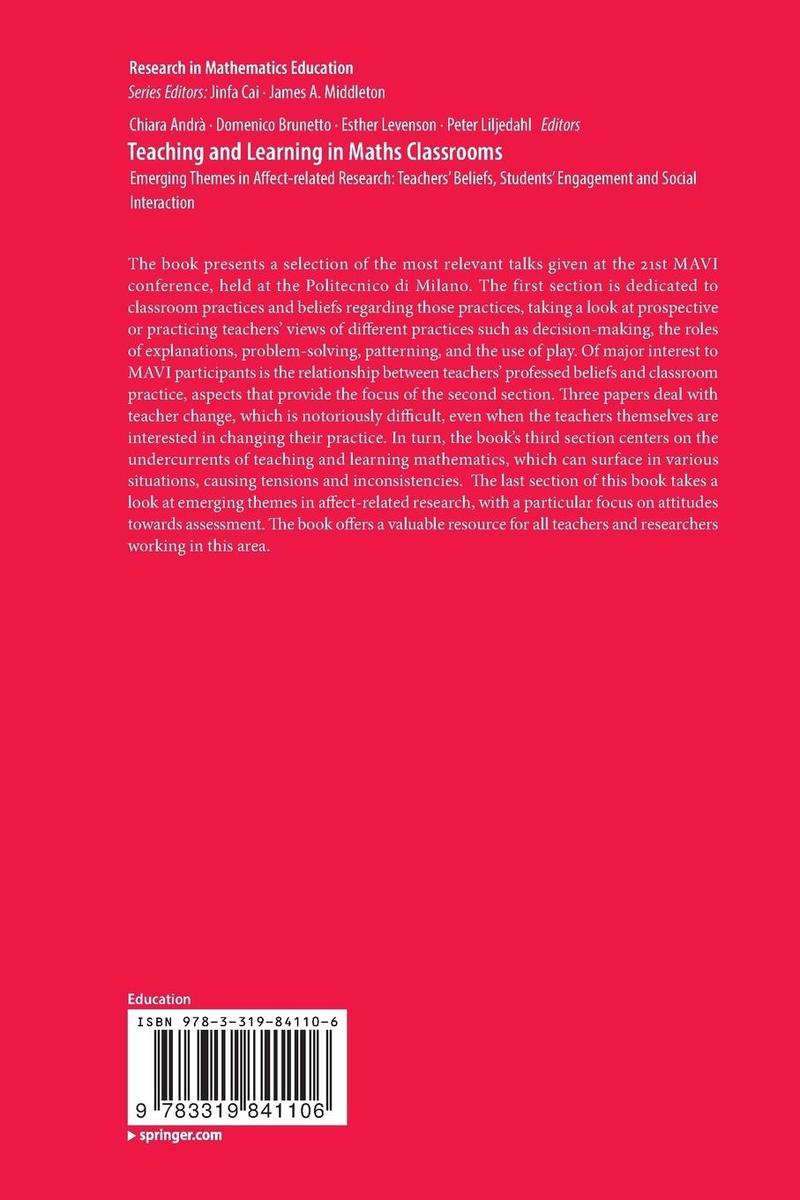
1 Teaching and learning in math classrooms. - 2 Foreword. - 3 Introduction. - Part I Classroom practices: explanation, problem-solving, patterning, decision-making, drawings and games 4 Prospective primary teachers beliefs regarding the roles of explanations in the classroom. - 5 Defining, drawing, and continuing repeating patterns: Preschool teachers self-efficacy and knowledge. - 6 Primary school students images of problem solving in mathematics. - 7 Secondary school mathematics teachers conceptions on data-based decision-making: Insights from four Japanese cases. - 8 Teachers activities during a mathematics lesson as seen in third graders drawings- 9 Serious frivolity: exploring play in UK secondary mathematics classrooms. - Part II Teachers beliefs, changing beliefs and the role of the environment. - 10 In-service math teachers autobiographical narratives: the role of metaphors. - 11 A contribution to the relation between teachers professed and enacted beliefs. - 12 Raising attainment: What might we learn from teachers beliefs about their best and worst mathematics students? . - 13 Numeracy task design: A case of changing mathematics teaching practice. - 14 Math lessons: from flipped to amalgamated, from teacher- to learner-centered. - 15 Emotional expressions as a window to processes of change in a mathematics classroom s culture. - 16 Mathematics teachers conceptions of the classroom environment. - Part III Understanding the undercurrents: tensions, inconsistencies and the social turn. - 17 Teacher tensions: the case of Naomi. - 18 Towards inconsistencies of parents beliefs about teaching and learning mathematics. - 19 Evoking the feeling of uncertainty for enhancing conceptual knowledge. - 20 Criteria for identifying students as exceptional in a mathematical camp for `gifted students. - 21 Identity and rationality in classroom discussion: developing and testing an analytical toolkit. - 22 Developing an analyzing tool for dynamic mathematics-related student interaction regarding affect, cognition and participation. - Part IV Emerging themes in affect-related research: engagement, fear, perfectionism . . . and assessment. - 23 Motivating desires for classroom engagement in the learning of mathematics. - 24 What are students afraid of when they say they are afraid of mathematics? . - 25 What is perfectionism in mathematical task solving? . - 26 Gender differences concerning pupils beliefs on teaching methods and mathematical worldviews at lower secondary schools. - 27 Every time I fell down (made a mistake), I could get up (correct) : affective factors in formative assessment practices with classroom connected technologies. - 28 Teachers affect towards the external standardised assessment of students mathematical competencies. - 29 Conclusion.
Es wurden noch keine Bewertungen abgegeben. Schreiben Sie die erste Bewertung zu "Teaching and Learning in Maths Classrooms" und helfen Sie damit anderen bei der Kaufentscheidung.











