As one of the most influential thinkers of the modern age, Karl Marx's political philosophy has resounded throughout politics and history, from the nineteenth century to the present day. In recent times however the concept of 'Marxism' has become a vague term, of uncertain and contestable definition, increasingly inaccessible to those new to Marx's writings. How are we to understand 'Marxism' when it has become so open to appropriation?
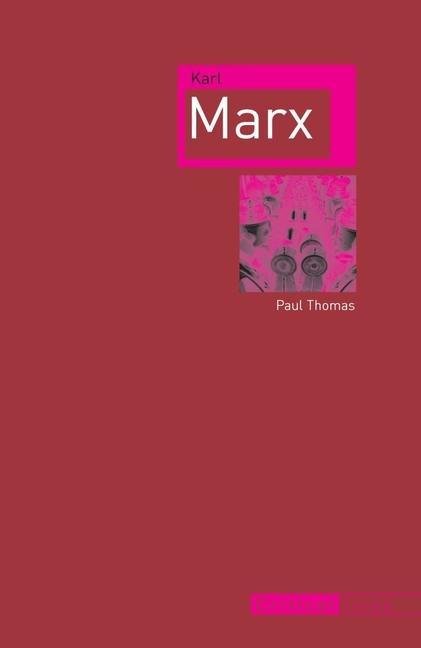
In Karl Marx, Paul Thomas introduces the reader to Marx's life and writings, to show how each cast light on the other. Concise yet detailed, Thomas concentrates directly on Marx's nineteenth-century life and works to give a clear, precise guide to Marx's own thought and action. The book relates Marx's development as a critical thinker and revolutionary politician to events that took place in his own lifetime, events that strongly influenced his doctrines.
A cogent, jargon-free introduction, Karl Marx welcomes those new to Marx's life and work, as well as having much to say to students and scholars of political theory and history.
He was relatively unknown in his lifetime, but Karl Marx's theories about society, economics, and politics changed the world, led to the Russian Revolution and the formation of the Soviet Union and the creation of the People's Republic of China, and inspired variants from Leninism and Stalinism to Trotskyism and Maoism. Marx is one of the most influential thinkers of the modern age, but in recent times "Marxism" has become a vague, contestable, and uncertain term. In this concise, accessible book, Paul Thomas casts a clarifying light on Marx's life and writings, providing a cogent introduction to a contemporary audience.
Illuminating Marx's development as a critical thinker and revolutionary politician, Thomas explores how the events of Marx's life influenced his doctrines. Thomas follows Marx from his birth into a wealthy family in Prussia, to his period of study of philosophy at the universities of Bonn and Berlin and his subsequent work as a journalist for radical newspapers in Cologne and Paris, where he began to develop the concepts that would lead to Marxism. As Marx found himself exiled to Brussels and finally to London, Thomas illustrates how he was inspired by his relationships with other socialist thinkers, particularly Friedrich Engels, and the tumultuous and fluctuating state of the governments in Europe. These experiences and their influence on Marx inspired The Communist Manifesto and Das Kapital, along with the many other books and pamphlets that continue to be read and discussed today. A valuable resource for anyone trying to understand the governments, wars, and movements of the twentieth and twenty-first centuries, Karl Marx is an enlightening book about this potent thinker and the world that created him.