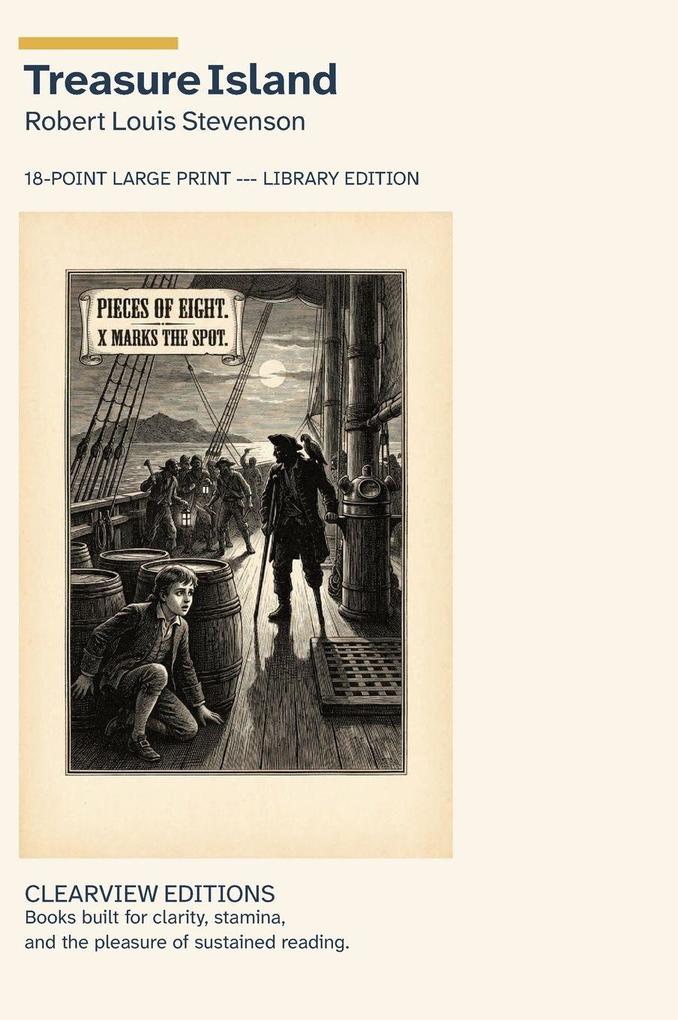
Robert Louis Stevenson's Treasure Island follows Jim Hawkins from the Admiral Benbow inn to an island marked by a dead pirate's map. Jim begins as an observant boy living with his parents at the inn. The arrival of Billy Bones, an old seaman guarding a sea chest, draws Jim into a struggle over the papers of Captain Flint. After danger reaches the inn, Jim brings the recovered map to Dr. Livesey and Squire Trelawney. Their plan to find the treasure carries Jim aboard the Hispaniola and into a company whose purposes are not what they first appear.
Long John Silver stands at the center of that uncertainty. He is the ship's cook, an experienced sailor, and a persuasive companion to Jim; he is also the organizer of the mutiny. Stevenson allows Silver to be charming, threatening, resourceful, and changeable in the same scene. Jim's response to him is correspondingly complicated. The book does not reduce their relationship to a simple contest between innocence and villainy. Jim learns to listen, judge risk, act alone, and live with the consequences of decisions made before he can know their full cost.
The voyage unfolds through Jim's first-person account, with a section narrated by Dr. Livesey while Jim is separated from his companions. The shifting account follows the discovery of the mutiny, the loyal party's defense of the stockade, Jim's meeting with the marooned Ben Gunn, his dangerous journey in the coracle, and the struggle for control of the Hispaniola. Captain Smollett, Squire Trelawney, Dr. Livesey, Israel Hands, Ben Gunn, and the mutineers each bring different knowledge and motives to the expedition. The treasure hunt becomes a test of loyalty, leadership, judgment, and survival.
This complete reading text contains six named parts and thirty-four chapters, beginning with "The Old Buccaneer" and ending with "And Last." It preserves the novel's movement between the Admiral Benbow, Bristol, the voyage, the island, the stockade, the ship, and the final search for Flint's hoard. It also preserves Stevenson's historical wording, punctuation, nautical vocabulary, dialogue, and descriptive detail. Readers encounter the familiar map, black spot, one-legged seaman, parrot, buried treasure, and pirate songs within the fuller narrative that gave those images their lasting force.
This edition retains the Louis Rhead illustrations associated with the Project Gutenberg Ebook No. 120 source, including scenes, decorations, captions, and the illustrated initials at all thirty-four chapter openings. The pictures mark transitions and emphasize incidents without replacing Stevenson's words. Their varied scale and placement give the book a visual rhythm that follows Jim from the Admiral Benbow through the voyage, mutiny, island, stockade, and final search. The 7 by 10 inch casebound format sets the complete story in approximately 18-point Atkinson Hyperlegible Next type on approximately 27-point baselines. Ragged-right paragraphs and line endings without automatic word division keep the spacious pages easy to follow while preserving the illustrated structure.
First published in book form in 1883, Treasure Island remains notable for the precision of its storytelling as much as for its influence on later pirate adventures. Suspense grows from what Jim sees and overhears, from divided loyalties aboard ship, and from the changing balance of power after landfall. The novel also pays close attention to practical action: provisioning a voyage, reading terrain, moving supplies, handling a small boat, defending a position, and deciding whom to trust. Its moral world is active rather than tidy. Courage can coexist with recklessness, loyalty with self-interest, and rescue with negotiation.
















![The Future of Soviet Science [1985]](/_next/image?url=https%3A%2F%2Fmedia2.hugendubel.de%2Fshop%2Fcoverscans%2F549%2F54925535_9798259516137_xl.jpg&w=3840&q=75)