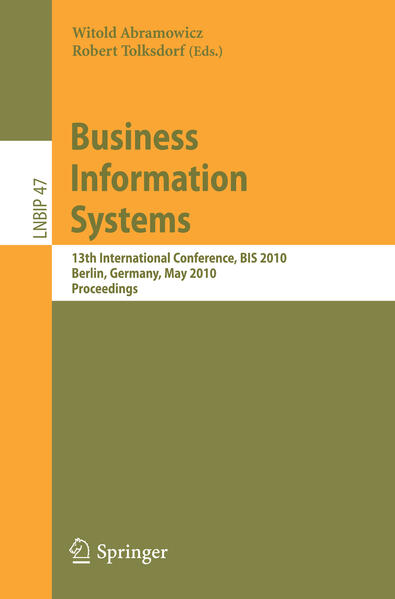
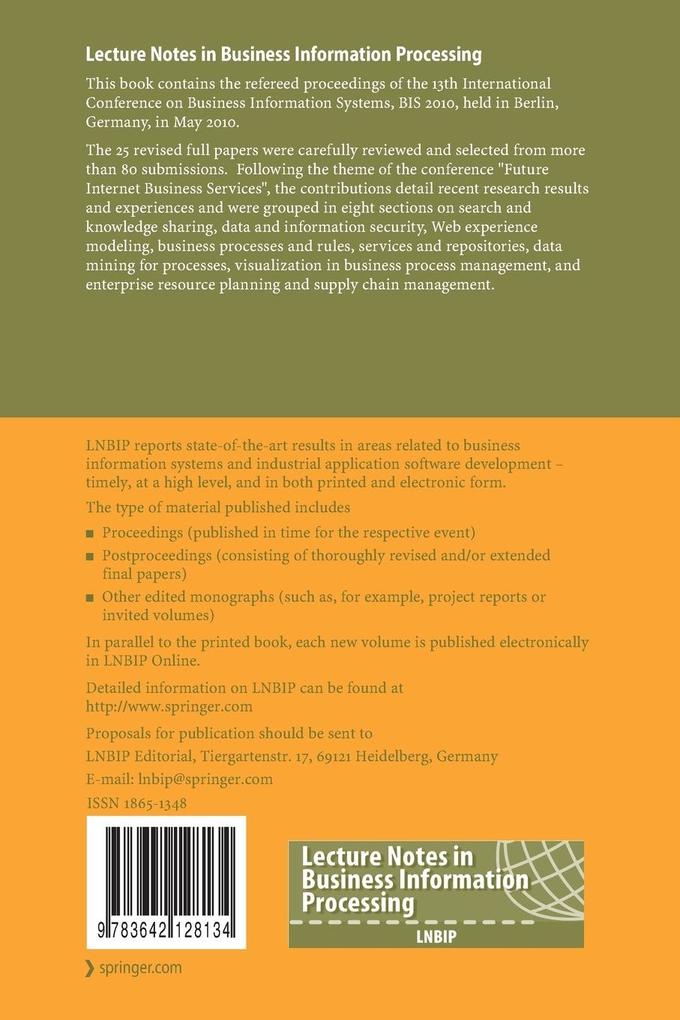
BIS 2010 held on 3 5 May 2010 in Berlin, Germany was the 13th in a series of international conferences on Business Information Systems. The BIS conference series has been recognised by professionals from its very beginning as a forum for the exchange and dissemination of topical research in the development, - plementation, application and improvement of computer systems for business processes. The theme ofthe conferencewas Future InternetBusiness Services. A n- ber of new initiatives are already underway to address the challenges related to explosive development of Internet applications, hence the conference topics: Searchand KnowledgeSharing, Data and InformationSecurity, Web Experience Modelling. Although many people announced that SOA was dead there is - doubtedly a strong need for service-orientation. This was addressed by a topic: Services and Repositories. More and more e? ort is put on explaining and und- standing complex processes as could be seen in topics: Business Processes and Rules, Data Mining for Processes, Visualisation in BPM. Finally, the classical business aspects were covered in session: ERP and SCM. Altogether, a set of 25 papers illustrating these trends were selected for the presentation during the main event, grouped in 8 sessions. The Program C- mittee consisted of almost 100 members who carefully evaluated all the subm- ted papers. Each submission was reviewed on the average by 3. 1 programme committee members. Only the best quality papers were selected, resulting in an acceptance rate of less than 30%.
Inhaltsverzeichnis
Session 1. Search and Knowledge Sharing. - Faceted Wikipedia Search. - A Model of Cross-Functional Coopetition in Software Development Project Teams. - Using Probabilistic Topic Models in Enterprise Social Software. - Session 2. Data and Information Security. - Using SPARQL and SPIN for Data Quality Management on the Semantic Web. - Quality in Blogs: How to Find the Best User Generated Content. - Avoiding Inconsistency in User Preferences for Data Quality Aware Queries. - Session 3. Web Experience Modelling. - Textractor: A Framework for Extracting Relevant Domain Concepts from Irregular Corporate Textual Datasets. - Comparing Intended and Real Usage in Web Portal: Temporal Logic and Data Mining. - Capturing Eye Tracking Data for Customer Profiling. - Session 4. Business Processes and Rules. - Consistency Checking of Compliance Rules. - From Economic Drivers to B2B Process Models: A Mapping from REA to UMM. - Using Surveys to Evaluate a Business Rules Based Development Approach. - Session 5. Services and Repositories. - Identification of Services through Functional Decomposition of Business Processes. - Requirements for a Business Process Model Repository: A Stakeholders Perspective. - Supporting Complex Business Information Systems. - Session 6. Data Mining for Processes. - On Integrating Data Mining into Business Processes. - From Process Execution towards a Business Process Intelligence. - Auditing Workflow Executions against Dataflow Policies. - Workflow Data Footprints. - Session 7. Visualisation in BPM. - On the Cognitive Effectiveness of Routing Symbols in Process Modeling Languages. - Visualising Business Capabilities in the Context of Business Analysis. - A Model Driven Engineering Approach for Modelling Versions of Business Processes using BPMN. - Session 8. ERP and SCM. - ValuePropositions in Service Oriented Business Models for ERP: Case Studies. - Event-Driven Business Intelligence Architecture for Real-Time Process Execution in Supply Chains. - Production Inventory and Enterprise System Implementation: An Ex-ante No-Cost Based Evaluation.