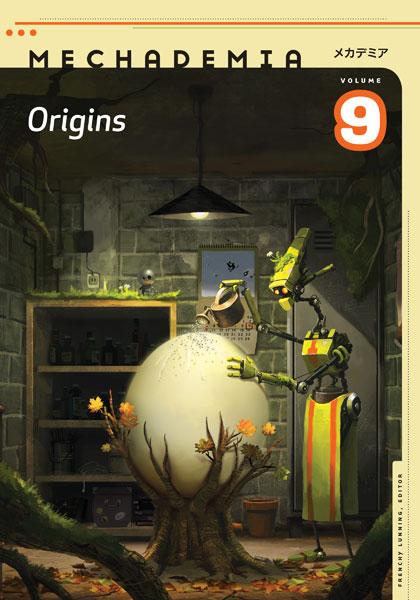
If the source of manga and anime is physically located in Japan, the temptation for many critics and scholars is to ask what aspects of Japanese culture and history gave rise to these media. This ninth volume of Mechademia-an annual collection of critical work on anime and manga-challenges the tendency to answer the question of origins by reductively generalizing and essentializing “Japaneseness.”
The essays brought together in Mechademia 9 lead us to understand the extent to which “Japan” might be seen as an idea generated by anime, manga, and other texts rather than the other way around. What is it that manga and anime produce that no other medium can precisely duplicate? Is anime its own medium or a genre of animation-or something in between? And how must we adapt existing critical modes in order to read these new kinds of texts? While the authors begin with similar questions about the roots of Japanese popular culture and media, they invoke a wide range of theoretical work in the search for answers, including feminist criticism, disability studies, poststructuralist textual criticism, postcolonialism, art history, film theory, phenomenology, and more. Richly provocative and insightful, Mechademia 9 both enacts and resists the pursuit of fixed starting points, inspiring further creative investigation of this global artistic phenomenon.
Contributors: Stephen R. Anderson; Dale K. Andrews, Tohoku Gakuin U; Andrew BallÚs; Jodie Beck; Christopher Bolton, Williams College; Kukhee Choo, Tulane U; Ranya Denison, U of East Anglia; Lucy Fraser; Fujimoto Yukari, Meiji U, Japan; Forrest Greenwood; Imamura Taihei; Seth Jacobowitz, Yale U; Kim Joon Yang; Thomas Lamarre, McGill U; Margherita Long, U of California, Riverside; Matsumoto Nobuyuki, Tokyo National Museum; Laura Miller, U of Missouri–St. Louis; Alexandra Roedder; Paul Roquet, Stanford U; Brian Ruh; Shun’ya Yoshimi, U of Tokyo; Alba G. Torrents.
Inhaltsverzeichnis
Contents< BR> < BR> Dedication to Dr. John A. Lent< BR> < BR> Introduction< BR> Christopher Bolton< BR> < BR> Part I. Subjects of Desire< BR> Hagio Moto’ s Nuclear Manga and the Promise of Eco-Feminist Desire< BR> Margherita Long< BR> Where Is My Place in the World? : Early ShÔ jo Manga Portrayals of Lesbianism< BR> Fujimoto Yukari< BR> Translated by Lucy Fraser< BR> Between Men, Androids, and Robots: Assaying Mechanical Man in Meiji Literature and Visual Culture< BR> Seth Jacobowitz< BR> < BR> Part II. Bodies in Motion< BR> Carbon as Creation: On Tsuji Naoyuki’ s Charcoal Anime< BR> Paul Roquet< BR> Powers of (Dis)Ability: Toward a Bodily Origin in Mushishi< BR> Steven R. Anderson< BR> South Korea and the Sub-Empire of Anime: Kinesthetics of Subcontracted Animation Production< BR> Kim Joon Yang< BR> < BR> Part III. Boundaries< BR> Japanese Cartoon Films< BR> Imamura Taihei< BR> Translated by Thomas Lamarre< BR> From Street Corner to Living Room: Domestication of TV Culture and National Time/Narrative< BR> Shun’ ya Yoshimi< BR> Translated by Jodie Beck< BR> Hyperbolic Nationalism: South Korea’ s Shadow Animation Industry< BR> Kukhee Choo< BR> Conceptualizing Anime and the Database Fantasyscape< BR> Brian Ruh< BR> < BR> Part IV. Rescripting History< BR> Rebranding Himiko, the Shaman Queen of Ancient History< BR> Laura Miller< BR> Tezuka’ s Buddha at the Tokyo National Museum: An Interview with Matsumoto Nobuyuki< BR> Christopher Bolton< BR> Genesis at the Shrine: The Votive Art of an Anime Pilgrimage< BR> Dale K. Andrews< BR> < BR> Part V. Repetition, Remediation, Adaptation< BR> The Girl at the Center of the World: Gender, Genre, and Remediation in BishÔ jo Media Works< BR> Forrest Greenwood< BR> The Localization of Kiki’ s Delivery Service< BR> Alexandra Roedder< BR> Franchising and Failure: Discourses of Failure within the Japanese-American Speed Racer Franchise< BR> Rayna Denison< BR> Evangelion as Second Impact: Forever Changing That Which Never Was< BR> Andreu BallÚ s and Alba G. Torrents< BR> From Ground Zero to Degree Zero: Akira from Origin to Oblivion< BR> Christopher Bolton< BR> < BR> Contributors< BR> < BR> < BR>