Bücher versandkostenfrei*100 Tage Rückgaberecht***Abholung in über 100 Filialen
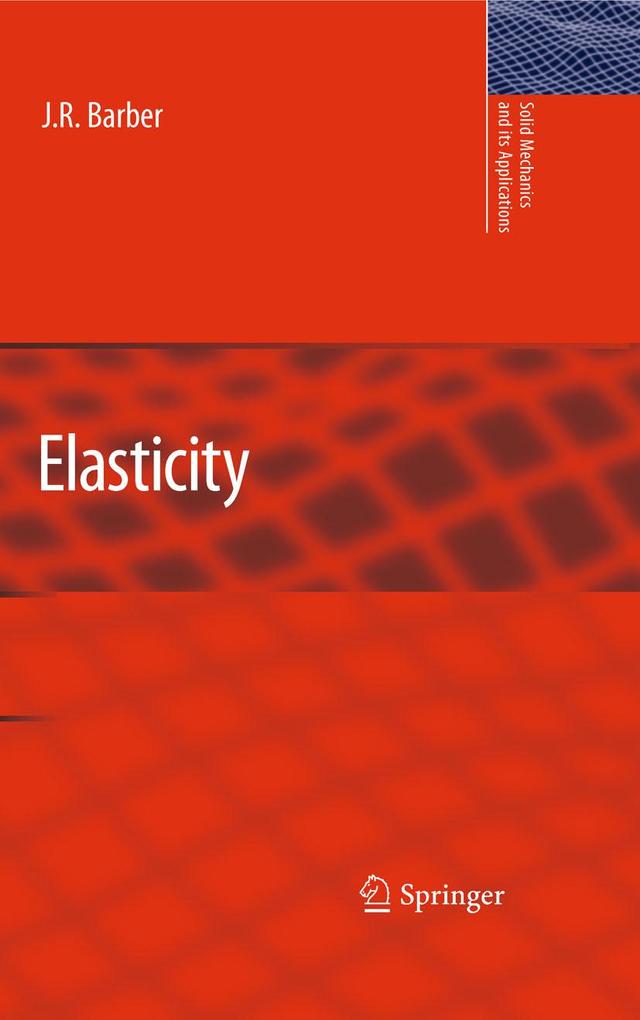
Inhaltsverzeichnis
Part I GENERAL CONSIDERATIONS ; 1 Introduction; 1. 1 Notation for stress and displacement ; 1. 1. 1 Stress; 1. 1. 2 Index and vector notation and the summationconvention; 1. 1. 3 Vector operators in index notation; 1. 1. 4 Vectors, tensors and transformation rules; 1. 1. 5 Principal stresses and Von Mises stress ; ; 1. 1. 6 Displacement; ; 1. 2 Strains and their relation to displacements; ; 1. 2. 1 Tensile strain; ; 1. 2. 2 Rotation and shear strain; ; 1. 2. 3 Transformation of co ordinates; ; 1. 2. 4 Definition of shear strain; ; 1. 3 Stressstrain relations; ; 1. 3. 1 Lam e s content; 1. 3. 2 Dilatation and bulk modulus ; PROBLEMS; 2 Equilibrium and compatibility; 2. 1 Equilibrium equations ; 2. 2 Compatibility equations; 2. 2. 1 The significance of the compatibility equations ; 2. 3 Equilibrium equations in terms of displacements ; PROBLEMS; Part II TWODIMENSIONAL PROBLEMS ; 3 Plane strain and plane stress ; 3. 1 Plane strain ; 3. 1. 1 The corrective solution; 3. 1. 2 SaintVenant s principle ; 3. 2 Plane stress; 3. 2. 2 Relationship between plane stress and plane strain; PROBLEMS; 4 Stress function formulation ; 4. 1 The concept of a scalar stress function ; 4. 2 Choice of a suitable form ; 4. 3 The Airy stress function; 4. 3. 1 Transformation of co ordinates; 4. 3. 2 Nonzero body forces ; 4. 4 The governing equation ; 4. 4. 1 The compatibility condition ; 4. 4. 2 Method of solution ; 4. 4. 3 Reduced dependence on elastic constants ; PROBLEMS; 5 Problems in rectangular co ordinates ; 5. 1 Biharmonic polynomial functions ; 5. 1. 1 Second and third degree polynomials; 5. 2 Rectangular beam problems ; 5. 2. 1 Bending of a beam by an end load; 5. 2. 2 Higher order polynomials a general strategy; 5. 2. 3 Manual solutions symmetry considerations ; 5. 3 Fourier series and transform solutions ; 5. 3. 1 Choice of form ; 5. 3. 2 Fourier transforms; PROBLEMS; 6 End effects ; 6. 1 Decaying solutions; 6. 2 The corrective solution; 6. 2. 1 Separatedvariable solutions ; 6. 2. 2 The eigenvalue problem ; 6. 3 Other SaintVenant problems; 6. 4 Mathieu s solution; PROBLEMS; 7 Body forces ; 7. 1 Stress function formulation ; 7. 1. 1 Conservative vector fields; 7. 1. 2 The compatibility condition ; 7. 2 Particular cases ; 7. 2. 1 Gravitational loading ; 7. 2. 2 Inertia forces ; 7. 2. 3 Quasistatic problems; 7. 2. 4 Rigidbody kinematics ; 7. 3 Solution for the stress function ; 7. 3. 1 The rotating rectangular beam; 7. 3. 2 Solution of the governing equation; 7. 4 Rotational acceleration; 7. 4. 1 The circular disk ; 7. 4. 2 The rectangular bar; 7. 4. 3 Weak boundary conditions and the equation of motion; PROBLEMS; 8 Problems in polar co ordinates ; 8. 1 Expressions for stress components; 8. 2 Strain components; 8. 3 Fourier series expansion; ; 8. 3. 1 Satisfaction of boundary conditions; 8. 3. 3 Degenerate cases ; 8. 4 The Michell solution ; 8. 4. 1 Hole in a tensile field ; PROBLEMS; 9 Calculation of displacements ; 9. 1 The cantilever with an end load ; 9. 1. 1 Rigidbody displacements and end conditions ; 9. 1. 2 Deflection of the free end; 9. 2 The circular hole ; 9. 3 Displacements for the Michell solution ; 9. 3. 1 Equilibrium considerations ; 9. 3. 2 The cylindrical pressure vessel ; PROBLEMS; 10 Curved beam problems ; 10. 1 Loading at the ends; 10. 1. 1 Pure bending ; ; 10. 1. 2 Force transmission; 10. 2 Eigenvalues and eigenfunctions ; 10. 3 The inhomogeneous problem; 10. 3. 1 Beam with sinusoidal loading ; 10. 3. 2 The nearsingular problem; 10. 4 Some general considerations ; 10. 4. 1 Conclusions; PROBLEMS; 11 Wedge problems ; 11. 1 Power law tractions; 11. 1. 1 Uniform tractions ; 11. 1. 2 The rectangular body revisited; 11. 1. 3 More general uniform loading ; 11. 1. 4 Eigenvalues for the wedge angle ; 11. 2 Williams asymptotic method ; 11. 2. 1 Acceptable singularities ; 11. 2. 2 Eigenfunction expansion; 11. 2. 3 Nature of the eigenvalues; 11. 2. 4 The singular stress fields ; 11. 2. 5 Other geometries; 11. 3 General loading of the faces; PROBLEMS; 12 Plane contact problems ; 12. 1 Selfsimilarity ; 12. 2 The Flamant Solution; 12. 3 The halfplane; 12. 3. 1 The normal forceFy; 12. 3. 2 The tangential force Fx; 12. 3. 3 Summary; 12. 4 Distributed normal tractions; 12. 5 Frictionless contact problems; 12. 5. 1 Method of solution ; 12. 5. 2 The flat punch ; 12. 5. 3 The cylindrical punch (Hertz problem) ; 12. 6 Problems with two deformable bodies ; 12. 7 Uncoupled problems ; 12. 7. 1 Contact of cylinders ; 12. 8 Combined normal and tangential loading ; 12. 8. 1 Cattaneo and Mindlin s problem ; 12. 8. 2 Steady rolling: Carter s solution ; PROBLEMS; 13 Forces dislocations and cracks ; 13. 1 The Kelvin solution; 13. 1. 1 Body force problems; 13. 2 Dislocations ; 13. 2. 1 Dislocations in Materials Science ; 13. 2. 2 Similarities and differences ; 13. 2. 3 Dislocations as Green s functions ; 13. 2. 4 Stress concentrations ; 13. 3 Crack problems ; 13. 3. 1 Linear Elastic Fracture Mechanics ; 13. 3. 2 Plane crack in a tensile field ; 13. 3. 3 Energy release rate ; 13. 4 Method of images ; PROBLEMS; 14 Thermoelasticity ; 14. 1 The governing equation; 14. 2 Heat conduction; 14. 3 Steadystate problems; 14. 3. 1 Dundurs Theorem ; PROBLEMS; 15 Antiplane shear ; 15. 1 Transformation of coordinates; 15. 2 Boundary conditions; 15. 3 The rectangular bar ; 15. 4 The concentrated line force ; 15. 5 The screw dislocation ; PROBLEMS; Part III END LOADING OF THE PRISMATIC BAR ; 16 Torsion of a prismatic bar ; 16. 1 Prandtl s stress function; 16. 1. 1 Solution of the governing equation; 16. 2 The membrane analogy ; 16. 3 Thinwalled open sections ; 16. 4 The rectangular bar ; 16. 5 Multiply connected (closed) sections ; 16. 5. 1 Thinwalled closed sections ; PROBLEMS; 17 Shear of a prismatic bar ; 17. 1 The semiinverse method ; 17. 2 Stress function formulation ; 17. 3 The boundary condition; 17. 3. 1 Integrability ; 17. 3. 2 Relation to the torsion problem ; 17. 4 Methods of solution; 17. 4. 1 The circular bar; 17. 4. 2 The rectangular bar ; PROBLEMS; Part IV COMPLEX VARIABLE FORMULATION ; 18 Preliminary mathematical results ; 18. 1 Holomorphic functions ; 18. 2 Harmonic functions; 18. 3 Biharmonic functions ; 18. 4Expressing real harmonic and biharmonic functions incomplex form ; 18. 4. 1 Biharmonic functions ; 18. 5 Line integrals ; 18. 5. 1 The residue theorem; 18. 5. 2 The Cauchy integral theorem ; 18. 6 Solution of harmonic boundary value problems ; 18. 6. 1 Direct method for the interior problem for a circle ; 18. 6. 2 Direct method for the exterior problem for a circle; 18. 6. 3 The half plane ; 18. 7 Conformal mapping; PROBLEMS; 19 Application to elasticity problems ; 19. 1 Representation of vectors; 19. 1. 1 Transformation of co ordinates; 19. 2 The antiplane problem ; 19. 2. 1 Solution of antiplane boundaryvalue problems ; 19. 3 Inplane deformations; 19. 3. 1 Expressions for stresses ; 19. 3. 2 Rigidbody displacement ; 19. 4 Relation between the Airy stress function and the complexpotentials ; 19. 5 Boundary tractions ; 19. 5. 1 Equilibrium considerations ; 19. 6 Boundaryvalue problems; 19. 6. 1 Solution of the interior problem for the circle ; 19. 6. 2 Solution of the exterior problem for the circle ; 19. 7 Conformal mapping for inplane problems ; 19. 7. 1 The elliptical hole ; PROBLEMS; Part V THREE DIMENSIONAL PROBLEMS ; 20 Displacement function solutions ; 20. 1 The strain potential ; 20. 2 The Galerkin vector ; 20. 3 The PapkovichNeuber solution ; 20. 3. 1 Change of co ordinate system; 20. 4 Completeness and uniqueness; 20. 4. 1 Methods of partial integration; 20. 5 Body forces; 20. 5. 1 Conservative body force fields 20. 5. 2 Nonconservative body force fields PROBLEMS; 21 The Boussinesq potentials; 21. 1 Solution A : The strain potential; 21. 2 Solution B 21. 3; Solution E : Rotational deformation; 21. 4 Other co ordinate systems; 21. 4. 1 Cylindrical polar co ordinates; 21. 4. 2 Spherical polar co ordinates; 21. 5 Solutions obtained by superposition; 21. 5. 1 Solution F : Frictionless isothermal contact problems; 21. 5. 2 Solution G: The surface free of normal traction; 21. 6 A threedimensional complex variable solution; PROBLEMS; 22 Thermoelastic displacement potentials; 22. 1 Plane problems; 22. 1. 1 Axisymmetricproblems for the cylinder ; 22. 1. 2 Steadystate plane problems ; 22. 1. 3 Heat flow perturbed by a circular hole ; 22. 1. 4 Plane stress ; 22. 2 The method of strain suppression; 22. 3 Steadystate temperature : Solution T; 22. 3. 1 Thermoelastic plane stress; PROBLEMS; 23 Singular solutions ; 23. 1 The source solution; 23. 1. 1 The centre of dilatation; 23. 1. 2 The Kelvin solution ; 23. 2 Dimensional considerations ; 23. 2. 1 The Boussinesq solution; 23. 3 Other singular solutions ; 23. 4 Image methods; 23. 4. 1 The tractionfree half space; PROBLEMS; 24 Spherical harmonics ; 24. 1 Fourier series solution; 24. 2 Reduction to Legendre s equation; 24. 3 Axisymmetric potentials and Legendre polynomials ; 24. 3. 1 Singular spherical harmonics; 24. 3. 2 Special cases; 24. 4 Nonaxisymmetric harmonics ; 24. 5 Cartesian and cylindrical polar co ordinates; 24. 6 Harmonic potentials with logarithmic terms; 24. 6. 1 Logarithmic functions for cylinder problems ; 24. 7 Nonaxisymmetric cylindrical potentials ; 24. 8 Spherical harmonics in complex notation ; 24. 8. 1 Bounded cylindrical harmonics; 24. 8. 2 Singular cylindrical harmonics ; PROBLEMS; 25 Cylinders and circular plates ; 25. 1 Axisymmetric problems for cylinders; 25. 1. 1 The solid cylinder ; 25. 1. 2 The hollow cylinder; 25. 2 Axisymmetric circular plates; 25. 2. 1 Uniformly loaded plate on a simple support; 25. 3 Nonaxisymmetric problems ; 25. 3. 1 Cylindrical cantilever with an end load; ; PROBLEMS; 26 Problems in spherical co ordinates; 26. 1 Solid and hollow spheres ; 26. 1. 1 The solid sphere in torsion; 26. 1. 2 Spherical hole in a tensile field; 26. 2 Conical bars ; 26. 2. 1 Conical bar transmitting an axial force; 26. 2. 2 Inhomogeneous problems ; 26. 2. 3 Nonaxisymmetric problems ; PROBLEMS; 27 Axisymmetric torsion ; 27. 1 The transmitted torque ; 27. 2 The governing equation ; 27. 3 Solution of the governing equation; 27. 4 The displacement field ; 27. 5 Cylindrical and conical bars; 27. 5. 1 The centre of rotation; 27. 6 The Saint Venant problem; PROBLEMS; 28 Theprismatic bar ; 28. 1 Power series solutions; 28. 1. 1 Superposition by differentiation ; 28. 1. 2 The problems
P0 and P1 Properties of the solution to Pm ;
28. 2 Solution of
Pm by integration ;
28. 3 The integration process ; 28. 4 The twodimensional problem ; 28. 5. 1The corrective antiplane solution ; 28. 5. 2 The circular bar; 28. 6 The corrective inplane solution; 28. 7 Corrective solutions using real stress functions ; 28. 7. 1 Airy function ; 28. 7. 2 Prandtl function ; 28. 8 Solution procedure ; 28. 9 Example ; 28. 9. 1 Problem ; 28. 9. 3 End conditions; PROBLEMS; 29 Frictionless contact ; 29. 1 Boundary conditions; 29. 1. 1 Mixed boundaryvalue problems; 29. 2 Determining the contact area ; 29. 3 Contact problems involving adhesive forces ; 30 The boundaryvalue problem ; 30. 1 Hankel transform methods; 30. 2 Collins Method ; 30. 2. 1 Indentation by a flat punch; 30. 2. 2 Integral representation; 30. 2. 3 Basic forms and surface values ; 30. 2. 4 Reduction to an Abel equation; 30. 2. 5 Smooth contact problems; 30. 2. 6 Choice of form; 30. 3 Nonaxisymmetric problems ; 30. 3. 1 The full stress field ; PROBLEMS; 31 The pennyshaped crack ; 31. 1 The pennyshaped crack in tension ; 31. 2 Thermoelastic problems ; PROBLEMS; 32 The interface crack ; 32. 1 The uncracked interface ; 32. 2 The corrective solution; 32. 2. 1 Global conditions; 32. 2. 2 Mixed conditions ; 32. 3 The pennyshaped crack in tension ; 32. 3. 1 Reduction to a single equation ; 32. 3. 2 Oscillatory singularities ; 32. 4 The contact solution ; 32. 5 Implications for Fracture Mechanics 33 Variational methods ; 33. 1 Strain energy ; 33. 1. 1 Strain energy density ; 33. 2 Conservation of energy ; 33. 3 Potential energy of the external forces; 33. 4 Theorem of minimum total potential energy ; 33. 5 Approximate solutions the RayleighRitz method ; 33. 6 Castigliano s second theorem; 33. 7 Approximations using Castigliano s second theorem; 33. 7. 1 The torsion problem ; 33. 7. 2 The inplane problem; 33. 8 Uniqueness and existence of solution ; 33. 8. 1 Singularities ; PROBLEMS; 34 The reciprocal theorem ; 34. 1 Maxwell s Theorem ; 34. 2 Betti s Theorem; 34. 3 Use of the theorem ; 34. 3. 1 A tilted punch problem; 34. 3. 2 Indentation of a halfspace; 34. 4 Thermoelastic problems ; PROBLEMS; A Using Maple and Mathematica.
Es wurden noch keine Bewertungen abgegeben. Schreiben Sie die erste Bewertung zu "Elasticity" und helfen Sie damit anderen bei der Kaufentscheidung.