Bücher versandkostenfrei*100 Tage Rückgaberecht***Abholung in über 100 Filialen
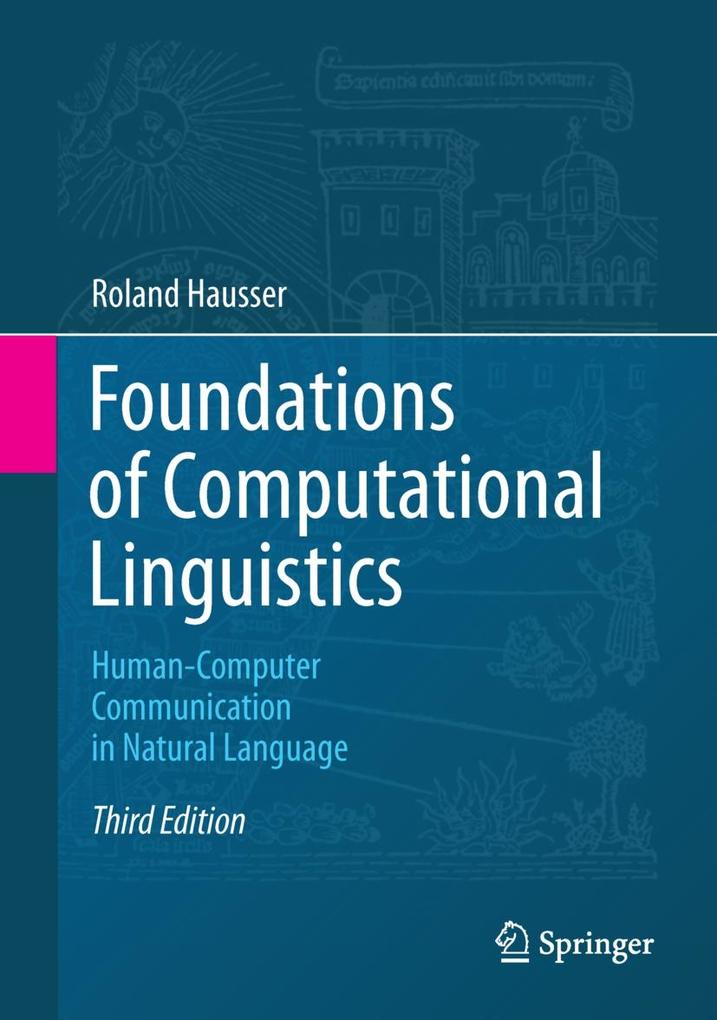
The content of this textbook is organized as a theory of language for the construction of talking robots. The main topic is the mechanism of natural language communication in both the speaker and the hearer.
In the third edition the author has modernized the text, leaving the overview of traditional, theoretical, and computational linguistics, analytic philosophy of language, and mathematical complexity theory with their historical backgrounds intact. The format of the empirical analyses of English and German syntax and semantics has been adapted to current practice; and Chaps. 22-24 have been rewritten to focus more sharply on the construction of a talking robot.
Inhaltsverzeichnis
Computational Analysis of Natural Language. - Smart vs. Solid Solutions. - Cognitive Foundations of Semantics. - Language Communication. - Using Language Signs on Suitable Contexts. - Structure and Functioning of Signs. - Formal Grammar. - Language Hierarchies and Complexity. - Basic Notions of Parsing. - Left-Associative Grammar (LAG). - Hierarchy of LA Grammar. - LA and PS Hierarchies in Comparison. - Words and Morphemes. - Word Form Recognition in LA Morph. - Corpus Analysis. - Basic Concepts of Syntax. - LA Syntax for English. - LA Syntax for German. - Three Kinds of Semantics. - Truth, Meaning, and Ontology. - Absolute and Contingent Propositions. - Database Semantics. - Functional Flow of a Talking Robot. - Conclusion. - Bibliography. - Name Index.
From the book reviews:
" This is a very abstract theoretical approach to language computation dating from Frege s principles, to DeSaussure s theories, and beyond. This book is meant for a wide audience including students, fellows, researchers, professors, and so on in the history of logical principles. I heartedly recommend it to everyone. " [Joseph J. Grenier, Amazon. com, July, 2014]
" Reviewing the logical foundations of computing, Hausser' s textbook now in its third revised edition, with new chapters provides the student of natural language with a computable theory of meaning without syntactic constituent structure. A quantifier-free fragment treats anaphora as addresses, where connectives are operations on patterns, its data structures support inference rules as patterns of grammar. Used all over the world in computational linguistics programs, this important book is recommended for anyone who grasps the limitations of a purely inductive, statistical approach to meaning and language processing. " [Alice G. B. ter Meulen, Université de Genève]
" Hausser rocks the foundations of truth-conditional semantics for natural language. " [Kiyong Lee, Korea University, Seoul]
" This book is a solid foundation for the computational modeling of human communication in natural language, and it is also a systematic explanation of how to make a talking robot. " [Haitao Liu, Zhejiang University, P. R. China]
Es wurden noch keine Bewertungen abgegeben. Schreiben Sie die erste Bewertung zu "Foundations of Computational Linguistics" und helfen Sie damit anderen bei der Kaufentscheidung.