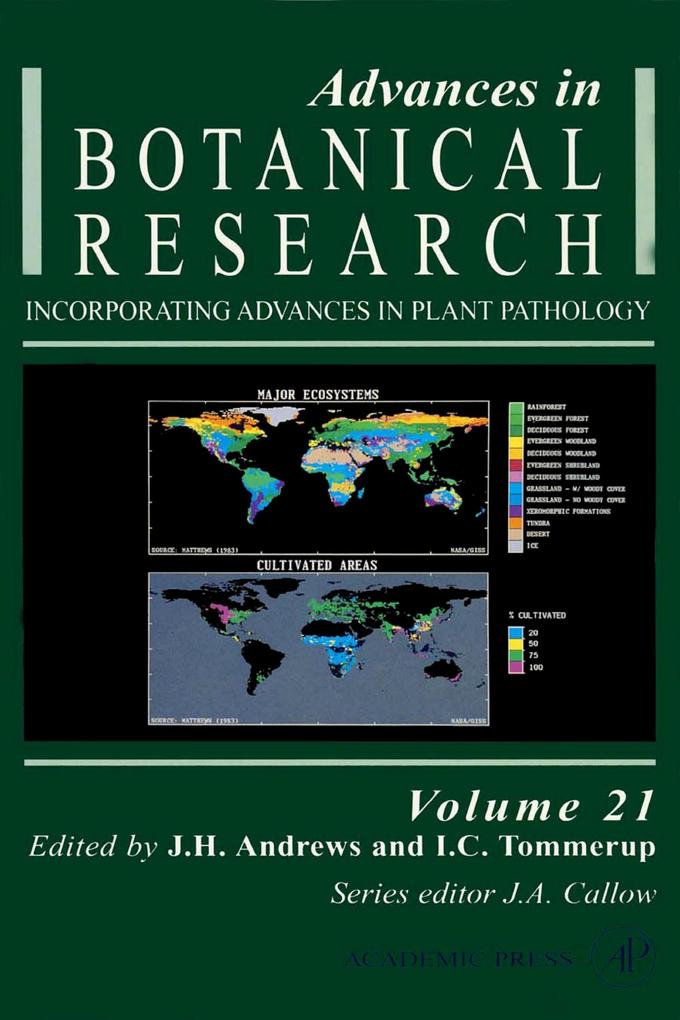
The twenty-first volume in the series focuses on plant pathology and is the first to integrate Advances in Plant Pathology into Advances in Botanical Research. The articles represented strive both to draw insights from relevant biological disciplines into the realm of plant pathology and to reveal the general principles of plant pathology to the broad audience of biologists, including undergraduate and postgraduate students, researchers and teachers. Kombrink and Somssich address how plant pathogens communicate at the genetic and biochemical level in determining resistance or susceptibility. This general theme is continued in articles on the nature of fungal wilt diseases (Beckman and Roberts); plant virus infection (de Zoeten); and the gene-for-gene interactions between plants and fungi (de Wit). Ehrlich takes up the timely issue of how pressure to expand and intensify agriculture is influencing agroecosystems and natural ecosystems on a global scale. The current status and future prospects of chestnuts, in health and disease, is considered by Anagnostakis. In an article on phytoplasmas, Kirkpatrick and Smart review the recent application of molecular techniques to the inference of taxonomic and phylogenetic relationships among mycoplasma-like organisms. To conclude the volume, Savary and colleagues show how a form of systems analysis can be used to handle large and complex data sets in epidemology.
Inhaltsverzeichnis
1;Front Cover;1 2;Advances in Botanical Research: Incorporating Advances in Plant Pathology;4 3;Copyright Page;5 4;Contents;6 5;Contributors to Volume 21;12 6;Series Preface;14 7;Preface;16 8;Chapter 1. Defense Responses of Plants to Pathogens;18 8.1;I. Introduction;19 8.2;II. Pathogen Ingress and Plant Resistance;20 8.3;III. Classes of Plant Defense Responses;25 8.4;IV. Regulation of Defense Gene Expression;35 8.5;V. Defense Responses and Resistance;38 8.6;VI. Conclusions and Perspectives;41 8.7;Acknowledgements;42 8.8;References;43 9;Chapter 2. On the Nature and Genetic Basis for Resistance and Tolerance to Fungal Wilt Diseases of Plants;52 9.1;I. Introduction;53 9.2;II. Updating the Models;53 9.3;III. The Relationship Between Vascular Colonization and Foliar Symptoms;68 9.4;IV. Colonization in Single Gene and Polygene Resistant Plants;71 9.5;V. How the Pathogen Colonizes the Host;73 9.6;VI. Molecular Aspects of Wilt Disease;75 9.7;VII. Integrating Host Resistance and Other Forms of Biological Control;84 9.8;VIII. The Expressive Phase of Disease Development;87 9.9;IX. Putting it All Together;88 9.10;References;89 10;Chapter 3. Implication of Population Pressure on Agriculture and Ecosystems;96 10.1;I. Introduction;96 10.2;II. Carrying Capacity, Technology, and Sustainability;97 10.3;III. Population Growth;101 10.4;IV. Feeding the Billions;103 10.5;V. Agriculture's Resource Base;106 10.6;VI. Ecosystems and Agriculture;108 10.7;VII. Measuring Impacts;110 10.8;VIII. Nutritional Security;111 10.9;IX. The Rich-Poor Gap, Global Change, and Agriculture;113 10.10;X. The Outlook;114 10.11;References;119 10.12;A colour plate section appears between pages 8081;98 11;Chapter 4. Plant Virus Infection: Another Point of View;124 11.1;I. Introduction;124 11.2;II. The Plant as a Medium for Virus Replication;125 11.3;III. Level I Interactions: Virus Destabilizing Events at the Cell Surface;126 11.4;IV. Level II Interactions: The First Cycle of Replication;133 11.5;V. Level III Inte
ractions: Cell-to-cell and Long-distance Spread of the Infection;134 11.6;VI. Conclusion;138 11.7;Acknowledgements;139 11.8;References;139 12;Chapter 5. The Pathogens and Pests of Chestnuts;144 12.1;I. Introduction;144 12.2;II. Ink Disease;146 12.3;III. Chestnut Blight;147 12.4;IV. Chestnut Germplasm;156 12.5;V. Conclusion;160 12.6;References;162 13;Chapter 6. Fungal Avirulence Genes and Plant Resistance Genes: Unraveling the Molecular Basis of Gene-for-gene Interactions;166 13.1;I. Introduction;167 13.2;II. Fungal Avirulence Genes and Their Products;168 13.3;III. Defense Responses Induced by Race-Specific Elicitors;183 13.4;IV. Receptors for Race-specific Elicitors of C. fulvum;186 13.5;V. Fungal Resistance Genes in Plants;188 13.6;VI. Conclusions and Future Prospects for Exploitation of Avirulence Genes and Resistance Genes;196 13.7;Acknowledgements;197 13.8;References;197 14;Chapter 7. Phytoplasmas: Can Phylogeny Provide the Means to Understand Pathogenicity;206 14.1;I. Introduction;207 14.2;II. Phylogeny and Taxonomy of Mollicutes and MLOs;209 14.3;III. Prospects for Characterizing and Expressing Phytoplasma Genes;214 14.4;IV. Candidate Model Systems for Identifying Phytoplasma Plant Pathogenicity, Host Range, and Insect Transmission Genes;218 14.5;V. Summary;225 14.6;References;225 15;Chapter 8. Use of Categorical Information and Correspondence Analysis in Plant Disease Epidemiology;232 15.1;I. Introduction;233 15.2;II. Methodology;234 15.3;III. Examples;243 15.4;IV. Overview;254 15.5;References;257 16;AUTHOR INDEX;260 17;SUBJECT INDEX;275