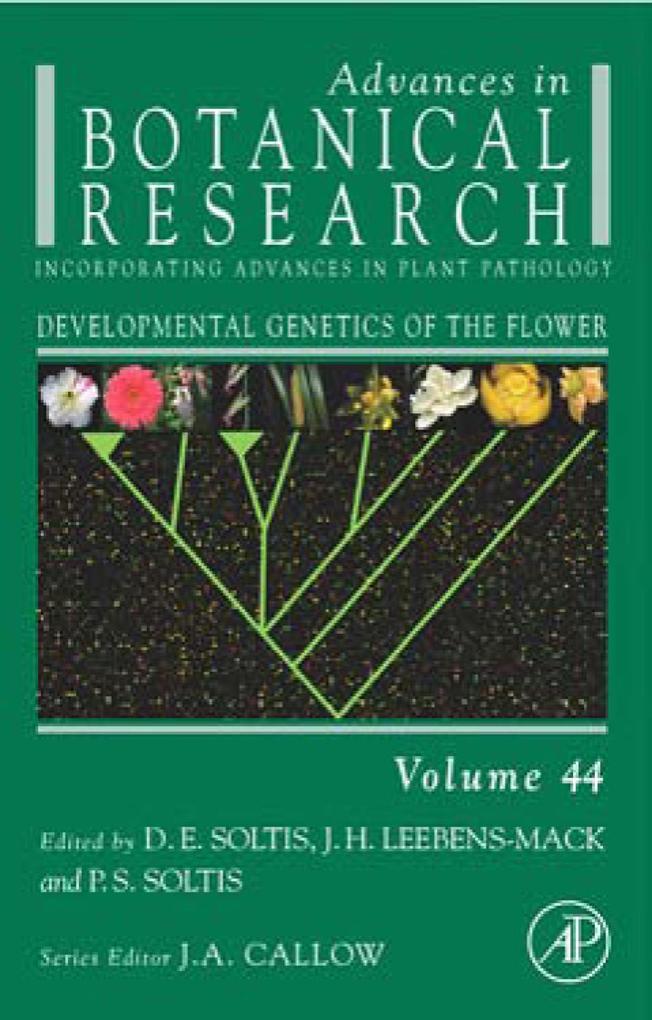
Current major interests in this area include the study of higher level phylogenetic relationships and character evolution in the angiosperms, floral evolution, the genetic basis of key floral differences in basal angiosperms, the genetic and genomic consequences of polyploid speciation, conservation genetics of rare plant species, and phylogeography. Developmental Genetics of the Flower provides a series of papers focused on the developmental genetics of flowering as well as the genetic control of the timing of flowering. Investigation of speciational mechanisms, evolutionary relationships, and character evolution in flowering plants and land plants utilizing a variety of experimental approaches are discussed. The chapters are excellent reviews of the current fast-moving area of research.
- Provides a brief review of genes known to regulate flower development
- Articles emphasize the classic ABC model of flower development
Inhaltsverzeichnis
1;Cover Page;1 2;Contents;6 3;Contributors to Volume 44;12 4;Contents of Volumes 34-43;16 5;Chapter 1: Angiosperm Floral Evolution: Morphological Developmental Framework;23 5.1;I. Introduction;24 5.2;II. Development: From Floral Primordium to Flower-Contingency of the Primary Morphological Surface;26 5.3;III. Evolution: From Simple to Complex Flowers-Contingency of the Developmental Program;28 5.4;IV. Floral Organs as Modules, Organ Categories (Organ Identity), and Their Evolution;29 5.4.1;A. Floral Organs as Modules;29 5.4.2;B. Sequence of Evolutionary Origin of Floral Organs;30 5.4.3;C. Ovules;31 5.4.4;D. Carpels;32 5.4.5;E. Stamens;33 5.4.6;F. Perianth Organs;34 5.4.7;G. Bracts and Bracteoles;36 5.5;V. Floral Phyllotaxis;37 5.6;VI. Floral Symmetry;42 5.7;VII. Angiospermy: Carpel Closure and Modes of Sealing;45 5.8;VIII. Postgenital Coherence;47 5.9;IX. Synorganization;48 5.9.1;A. What is Synorganization?;48 5.9.2;B. Means of Synorganization: Congenital and Postgenital Coherence;51 5.9.3;C. Sites of Synorganization;51 5.9.3.1;1. Synorganization among organs of the same whorl (organs of the same category);51 5.9.3.1.1;a. Perianth;51 5.9.3.1.2;b. Androecium;52 5.9.3.1.3;c. Gynoecium;53 5.9.3.2;2. Synorganization between whorls (organs of diVerent kinds);56 5.9.3.3;3. Synorganization between flowers in an inflorescence;57 5.10;X. Plasticity of Organ Form in Development Shaped by Floral Architecture or by Contiguous Parts;57 5.10.1;A. Monosymmetry and Synorganization;57 5.10.2;B. Autonomous Shapes and Imprinted Shapes, Positional Effects;58 5.11;XI. Architectural Extremes;59 5.12;XII. An Innovation of Flexibility: Escape from Constraints of Synorganized Flowers in Core Eudicots-Increase of Stamen Number and Decoupling of Sequence of Initiation of Stamens and Carpels by Ring Meristems;61 5.13;XIII. Potential Pitfalls of Generalizations from Model Plants;65 5.14;XIV. Conclusions and Questions;67 5.15;Acknowledgments;68 5.16;References;68 6;Chapter 2: Recent Developments
Regarding the Evolutionary Origin of Flowers;85 6.1;I. Introduction;86 6.2;II. What Needs to Be Explained for the Origin of the Flower?;93 6.3;III. Important Attributes of the Ancestral Flower;96 6.3.1;A. Bisexuality;96 6.3.2;B. The Carpel;97 6.3.3;C. The Stamen;97 6.3.4;D. The Angiosperm Ovule;98 6.3.5;E. Pollen;98 6.4;IV. What Should a Theory Do?;99 6.5;V. The Anthophyte Theory;100 6.6;VI. Molecular Phylogenetic Analyses of Seed Plants Undermine the Anthophyte Theory;101 6.6.1;A. Molecular Phylogenetic Studies Using Nonduplicated Genes;102 6.6.2;B. Molecular Phylogenetic Studies with Duplicated Genes;110 6.6.3;C. Morphological Phylogenetic Analyses;112 6.7;VII. The Mostly Male Theory;117 6.7.1;A. The Genesis of the Mostly Male Theory;117 6.7.2;B. New Evidence Regarding The Mostly Male Theory;120 6.7.3;C. LFY Expression and Inferred Function;121 6.7.4;D. Dorsiventrality of the Outer Integument and of the Cupule Wall;125 6.8;VIII. Alternatives and Modifications of the Mostly Male Theory;126 6.9;IX. Baum and Hileman's Scenario for Flower Origins;129 6.10;X. Doyle's Caytonia-Glossopterid Model for the Origin of the Carpel;130 6.11;XI. Meyen's Gametoheterotopy Theory (and Krassilov's (1997) Book);132 6.12;XII. Double Fertilization and Friedman and Williams' Modular Scenario;134 6.13;XIII. Overall Conclusions;138 6.14;Acknowledgments;138 6.15;References;138 7;Chapter 3: Duplication, Diversification, and Comparative Genetics of Angiosperm MADS-Box Genes;151 7.1;I. Introduction;152 7.2;II. Rationale for Exploring MADS-Box Gene Diversification;153 7.3;III. Flower Morphologies Across the Angiosperms;154 7.3.1;A. Fossil Evidence;155 7.3.2;B. What is the Closest Extant Nonangiosperm?;156 7.3.3;C. What Angiosperm is Sister to Other Extant Flowering Plants?;156 7.4;IV. Perianth Diversity Across the Major Clades of Angiosperms;157 7.5;V. How Did the Genetic Mechanisms Controlling These New Morphologies Evolve?;158 7.5.1;A. Analysis Of Perianth Development In Arabidopsis, A Core
Eudicot;159 7.5.1.1;1. The floral homeotic genes specify organ identity;160 7.5.1.2;2. Expression of AP3 and PI;161 7.5.1.3;3. AP3 and PI form protein complexes;162 7.5.1.4;4. Downstream targets of AP3 and PI;162 7.5.2;B. Conservation and Diversification in Expression and Function Of AP3 and PI Genes in the Angiosperms;163 7.5.2.1;1. Gene duplication in the AP3 and PI gene lineages;164 7.5.2.2;2. An exploration of the changing roles of the AP3 and PI lineage genes;165 7.6;VI. Evolution of AP3 and PI Function;169 7.7;VII. How Do We Functionally Analyze MADS-Box Genes in Nonmodel Species?;170 7.8;VIII. Prospects;172 7.9;Acknowledgments;173 7.10;References;173 8;Chapter 4: Beyond the ABC-Model: Regulation of Floral Homeotic Genes;185 8.1;I. Introduction: The ABC-Model;186 8.2;II. Regulators of A-Function;192 8.2.1;A. Regulation of AP1 by Meristem Identity Genes;192 8.2.2;B. Regulation of AP1 by AG;194 8.3;III. Regulators of B-Function;195 8.3.1;A. Expression Patterns of B-Function Genes in Arabidopsis;195 8.3.2;B. Activation of B-Function Genes by LFY and AP1;196 8.3.3;C. SCFUFO E3 Ubiquitin Ligases as Regional Activator of B-Function Genes;197 8.3.4;D. Regulation of B-Function by SEP3;199 8.3.5;E. Control of the Inner Boundary of B-Function Gene Expression by Superman;200 8.3.6;F. The Autoregulatory Circuit of AP3/PI;201 8.3.7;G. GA Signaling and Early Bolting in Shortdays Affects AP3/PI Expression;202 8.4;IV. Regulators of C-Function;203 8.4.1;A. Positive Regulators of AG;204 8.4.1.1;1. Regulation of AG expression by LFY and WUS;204 8.4.1.2;2. Regulation of AG transcript processing by the HUA and HUA ENHANCER proteins;205 8.4.1.3;3. Regulation of C-function by SEP3;208 8.4.2;B. Negative Regulators of AG;208 8.4.2.1;1. Negative regulators of AG in vegetative tissues;209 8.4.2.2;2. AP2 as a repressor of AG in the perianth;210 8.4.2.3;3. LUG and SEU form a corepressor complex;211 8.4.2.4;4. BLR mediates repression of AG;212 8.4.2.5;5. RBE and UFO regulate the boundary
of AG expression;213 8.4.2.6;6. SAP has both positive and negative functions;213 8.4.2.7;7. Aintegumenta;214 8.4.2.8;8. C-Function regulators that do not directly regulate AG;215 8.4.3;C. Regulators of AG in the Ovule;215 8.5;V. Summary and Perspectives;216 8.6;Acknowledgments;218 8.7;References;218 9;Chapter 5: Missing Links: DNA-Binding and Target Gene Specificity of Floral Homeotic Proteins;231 9.1;I. Introduction;232 9.2;II. Binding of MADS-domain Proteins to DNA;233 9.3;III. Learning from Homeodomain Proteins in Animals;236 9.4;IV. CArG Galore: What For?;238 9.5;V. DNA Bending;239 9.6;VI. Does the Protein Concentration Matter?;241 9.7;VII. Protein-Protein Interactions: Elective Affinities;243 9.7.1;A. Role of Non-Mads Factors;243 9.7.2;B. Higher order Complexes and their Influence on Target Gene Specificity;245 9.8;VIII. Target Genes: Hints for Target Gene Specificity?;249 9.9;IX. Evolutionary Implications: Nothing in the MADS World Makes Sense Except in the Light of Target Gene Specificity;250 9.10;Acknowledgments;252 9.11;References;252 10;Chapter 6: Genetics of Floral Development in Petunia;259 10.1;I. Introduction;260 10.1.1;A. Solanaceae;260 10.1.2;B. The Genus Petunia;260 10.1.3;C. Petunia Flower Characteristics;261 10.1.4;D. Floral Diversity in the Petunia Clade: Pollination Syndromes;261 10.1.5;E. Research on Petunia Flower Development;263 10.1.6;F. Petunia in Molecular Studies;264 10.1.7;G. Floral Development;264 10.2;II. The Transition to Flowering;265 10.3;III. Meristem Identity Genes: Inflorescence and Flower Architecture;269 10.3.1;A. Petunia Inflorescence Architecture;270 10.4;IV. Floral Organ Identity Determination;273 10.4.1;A. The A-Function Genes;274 10.4.2;B. The B-Function Genes;276 10.4.2.1;1. GLO/PI lineage genes;276 10.4.2.2;2. DEF/AP3 lineage genes;277 10.4.2.3;3. PhDEF;278 10.4.2.4;4. PhTM6: an atypical and interesting B-function gene;278 10.4.2.5;5. Interactions between the Petunia B-function proteins;279 10.4.3;C. The C-Function Genes
;280 10.4.4;D. The D-Function Genes;283 10.4.4.1;1. Pistil and ovule development in Petunia;283 10.4.4.2;2. Interacting proteins;285 10.4.5;E. The E-Function Genes;286 10.5;V. Conclusions;290 10.6;Acknowledgments;292 10.7;References;292 11;Chapter 7: Flower Development: The Antirrhinum Perspective;301 11.1;I. Introduction;302 11.2;II. The Control of Floral Identity: Where the Differences Begin;303 11.3;III. The (A)BC-Model: Past Discoveries and Current Problems;304 11.3.1;A. The A-Function and its Dubious Role in the Control of Perianth Identity: The Relation Between Floral Meristem and Sepal Identity;305 11.3.2;B. The A-Function in the Spatial Control of C-Gene Expression;309 11.3.3;C. Additions to (A): Floral Functions Necessary for Manifestation of the B- and C-Control;313 11.3.4;D. The B-Function Proteins and their Partners in the Making of a Petal;314 11.3.5;E. The C-Function: PLE and FAR Together Control Reproductive Development;316 11.3.6;F. The Link Between the B- And C-Functions in Controlling Floral Determinacy;317 11.3.7;G. A Novel Definition of the (A)-Function in the (A)BC-Model to Recover its Universality;319 11.4;IV. Inflorescence and Floral Architecture;320 11.4.1;A. CEN: A Major Influence on Inflorescence Architecture;321 11.4.2;B. Incomposita: Aberrant Prophyll Initiation Impairs Floral Architecture;323 11.5;V. Floral Symmetry;325 11.5.1;A. The Players: Mutants With Symmetry Defects and the Genes Involved;325 11.5.2;B. A Possible Mechanism to Control Symmetry;328 11.5.3;C. Floral Asymmetry in Other Species;329 11.6;VI. Floral Color, Scent, and Cell Shape: The Skills of Antirrhinum to Attract Pollinators;330 11.6.1;A. Floral Color;331 11.6.2;B. The Production of Scent;331 11.6.3;C. MYB Transcription Factors Control Cell Shape;332 11.7;VII. Outlook;334 11.7.1;A. Present and Future Resources;335 11.7.2;B. Antirrhinum for Studying Diversity and Ecology;336 11.8;Acknowledgments;337 11.9;References;337 12;Chapter 8: Floral Developmental Genetics of Gerbe
ra (Asteraceae);345 12.1;I. Introduction;346 12.1.1;A. Design of Gerbera Flowers;349 12.1.2;B. Reverse Genetics Tools in Gerbera;351 12.2;II. Gerbera MADS-Box Genes;353 12.2.1;A. ABC-Model of Flower Development in Gerbera;354 12.2.2;B. Beyond the ABCs: Subfunctionalization of the Sepallata Genes in Gerbera;359 12.2.3;C. Control of Floral Meristem Fate by SEP Genes;363 12.3;III. Gerbera Genomics;365 12.4;IV. The Gerbera Capitulum;366 12.4.1;A. Regulation by a Radial Morphogenetic Gradient?;366 12.4.2;B. Some Speculative Models;367 12.5;V. Conclusions;369 12.6;References;369 13;Chapter 9: Gene Duplication and Floral Developmental Genetics of Basal Eudicots;375 13.1;I. Introduction;376 13.2;II. Evolution and Morphology of the Eudicots;376 13.3;III. Genetics of Floral Organ Identity in Model Species;379 13.3.1;A. THE ABC-Model and its Elaboration;379 13.3.2;B. The MIKC family of MADS-Box containing genes;381 13.4;IV. Gene Duplications Within the Basal Eudicot Grade;384 13.4.1;A. The APETALA3 Lineage;384 13.4.2;B. The APETALA1 Lineage;388 13.4.3;C. The Agamous Lineage;391 13.4.4;D. The Sepallata Subfamily;392 13.4.5;E. Broader Implications;394 13.5;V. Gene Duplications in the Early Branches of the Eudicot Radiation: The Ranunculales;395 13.6;VI. Summary;397 13.7;Acknowledgments;398 13.8;References;398 14;Chapter 10: Genetics of Grass Flower Development;407 14.1;I. Introduction;408 14.2;II. Grass Floral Morphology;410 14.3;III. Genetics of Grass Flower Development;412 14.3.1;A. MADS-Box Genes and Grass Flower Development: Rounding Up the Usual Suspects;412 14.3.1.1;1. A-class;413 14.3.1.2;2. B-class;417 14.3.1.3;3. C-class;419 14.3.1.4;4. D-class;421 14.3.1.5;5. E-class;422 14.3.2;B. Thinking Outside of the MADS-Box: How Forward Screens Reveal Non-MADS-Box Genes Important for Grass Floral Patterning;424 14.4;IV. Physical Interactions among MADS-Box Proteins: Function and Evolution;426 14.5;V. The Grass Family as a Model System for Evo-Devo;430 14.5.1;A. Gene Duplication a
nd Subfunctionalization;431 14.5.2;B. The Evolution of Derived Morphologies;433 14.5.3;C. Synteny and the Grass Family as an Integrated Genetic System;436 14.6;VI. Conclusions;437 14.7;Acknowledgments;439 14.8;References;439 15;Chapter 11: Developmental Gene Evolution and the Origin of Grass Inflorescence Diversity;447 15.1;I. Introduction;448 15.1.1;A. Tools for Evolutionary Developmental Genetics;448 15.1.2;B. The Grass Family;449 15.1.3;C. Grass Inflorescences vs Arabidopsis;450 15.1.4;D. Duplicate Genes, the Raw Material for Evolution of Novel Function;454 15.2;II. Methods;456 15.2.1;A. Choice of Genes and Taxa;456 15.2.2;B. Data, Alignment, and Polymerase Chain Reaction Primer Design;456 15.2.3;C. DNA Isolation, PCR, Subcloning, and Sequencing;457 15.2.4;D. Alignment and Phylogenetic Analysis;459 15.3;III. Morphological Variation and Molecular Evolution of Genes in Grass Inflorescences;459 15.3.1;A. Formation of Lateral Structures and Noncorrelation of Meristem Fates;459 15.3.1.1;1. Morphological variation;459 15.3.1.2;2. KNOTTED1-like genes;460 15.3.1.3;3. LAX PANICLE1/BARREN STALK1;464 15.3.1.4;4. MONOCULM1;464 15.3.1.5;5. Barren Inflorescence2;466 15.3.2;B. Number of Orders of Branching;466 15.3.3;C. Number of Branches at Each Order;467 15.3.3.1;1. Morphological variation;467 15.3.3.2;2. RICE CENTRORADIALIS;468 15.3.3.3;3. RAMOSA1;470 15.3.3.4;4. ABERRANT PANICLE ORGANIZATION;471 15.3.3.5;5. Grain Number 1A/CKX2;471 15.3.4;D. Phyllotaxis;472 15.3.4.1;1. Morphological variation;472 15.3.4.2;2. CLAVATA-like;473 15.3.4.3;3. ABPHYL1;475 15.3.5;E. Bracts and Leaves Subtending Branches;476 15.3.5.1;1. Morphological variation;476 15.3.5.2;2. LEAFY;476 15.3.6;F. Presence of a Terminal Spikelet;478 15.3.7;G. Elongation of Inflorescence Internodes;479 15.3.8;H. Glumes and Spikelets;479 15.3.8.1;1. Morphological variation;479 15.3.8.2;2. FRUITFULL 1/2/3;480 15.3.8.3;3. BRANCHED SILKLESS1/FRIZZY PANICLE1;483 15.3.9;I. Glume vs Lemma Identity;484 15.3.9.1;1. Morphologica
l variation;484 15.3.9.2;2. SEPALLATA genes;485 15.3.10;J. Floret Number;487 15.3.10.1;1. Morphological variation;487 15.3.10.2;2. INDETERMINATE SPIKELET1;488 15.4;IV. Conclusions;490 15.5;Acknowledgments;493 15.6;References;494 16;Chapter 12: Expression of Floral Regulators in Basal Angiosperms and the Origin and Evolution of ABC-Function;505 16.1;I. Introduction;506 16.2;II. Summary of the ABC-Model;507 16.2.1;A. The ABC-Model.;507 16.2.2;B. The Quartet Model;508 16.3;III. Alternatives to the ABC-Model;508 16.3.1;A. The Tulip/Lily Model;509 16.3.2;B. Shifting/Sliding Boundaries;509 16.3.3;C. Fading Borders;510 16.4;IV. Expression of Floral Regulators in Basal Angiosperms;511 16.4.1;A. Are Homologs of Arabidopsis A-, B-, and C-Function Genes Present in Basal Angiosperms?;511 16.4.2;B. Where and When are Homologs of the A-, B-, and C-Function Genes of Arabidopsis Expressed?;513 16.4.3;C. AGL6: A Candidate A-Function Gene in Basal Angiosperms;514 16.5;V. Correspondence Between Expression Patterns and Floral Morphology;515 16.6;VI. New Insights into the Evolution of Novel Floral Structures;516 16.7;VII. Derivation of the ABC-Model;517 16.8;VIII. Future Directions;518 16.8.1;A. The Role of Gene Duplications;518 16.8.2;B. Transcription Factor Complexes and the Origin of the ABC-Model: Testable Hypotheses;519 16.9;IX. Conclusions;520 16.10;References;524 17;Chapter 13: The Molecular Evolutionary Ecology of Plant Development: Flowering Time in Arabidopsis thaliana;529 17.1;I. Introduction;530 17.2;II. Evolutionary Ecology of Flowering Time;530 17.3;III. The Genetic Basis of Environmental Perception in Flowering Time Signaling;534 17.4;IV. Quantitative Trait Locus Mapping of Flowering Time Variation;536 17.5;V. Isolation of Genes Underlying Flowering Time Variation;538 17.6;VI. Microevolution of Flowering Time Loci;540 17.7;VII. Summary;543 17.8;Acknowledgments;543 17.9;References;543 18;Chapter 14: A Genomics Approach to the Study of Ancient Polyploidy and Floral Developm
ental Genetics;549 18.1;I. Introduction;550 18.1.1;A. Phylogenetic Context;550 18.1.2;B. Genomic Approaches;552 18.2;II. Widespread Polyploidy in Angiosperm History;553 18.3;III. Implications of Ancient Polyploidy for Comparative Genomics;555 18.3.1;A. Orthologs, Homeologs, and Paralogs;555 18.3.2;B. Characterizing the Fate of Duplicated Genes;556 18.3.3;C. A Gene Family Perspective on Genome Duplications;557 18.3.4;D. Shifts in Selective Constraint;559 18.4;IV. Comparative Analyses of Distantly Related Taxa Elucidate Gene Function in Arabidopsis;561 18.5;V. Future Prospects: Developing a Gene Family Framework to Characterize Plant Gene and Genome Evolution;563 18.6;Acknowledgments;564 18.7;References;564 19;Author Index;573 20;Subject Index;601