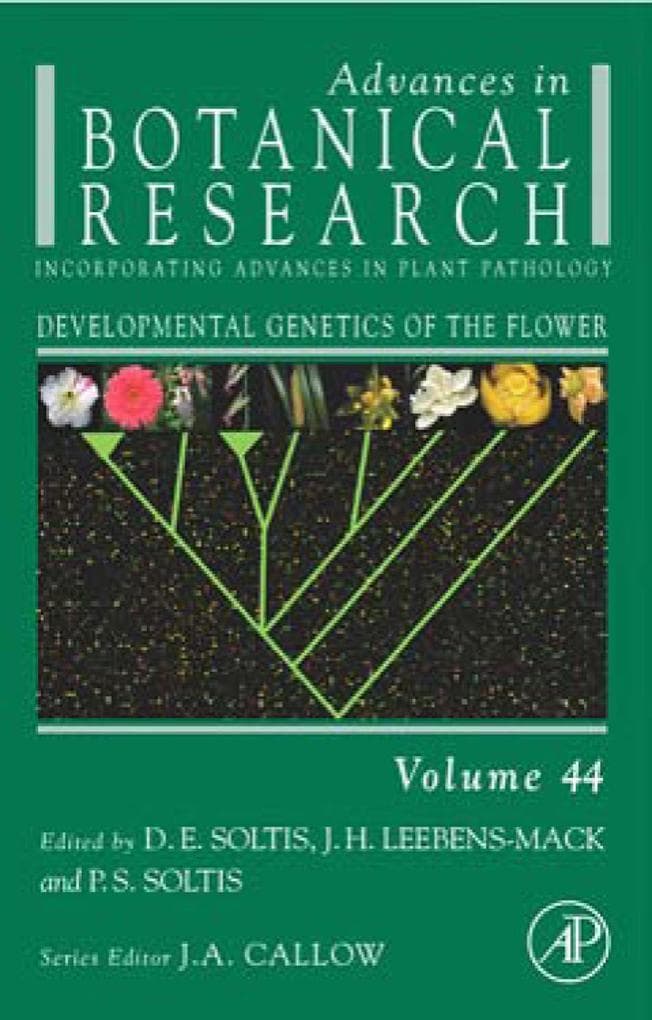
Edited by J. A. Callow and supported by an international Editorial Board, Advances in Botanical Research publishes in-depth and up-to-date reviews on a wide range of topics in plant sciences. Currently in its 43rd volume, the series features a wide range of reviews by recognized experts on all aspects of plant genetics, biochemistry, cell biology, molecular biology, physiology and ecology. This eclectic volume features four reviews on cutting-edge topics of interest to post-graduates and researchers alike.
- Includes such topics as defensive ecology of brown algae
- Multidisciplinary reviews written from a broad range of scientific perspectives
- Discusses opportunities for the control of brassicaceous weeds of cropping systems using mycoherbicides
- For over 40 years, series has enjoyed a reputation for excellence
- Contributors internationally recognized authorities in their respective fields
Inhaltsverzeichnis
1;Cover;1 2;Title Page;2 3;Editor-in-Chief;3 4;Copyright Page;5 5;Contents;6 6;Contributors To Volume 43;8 7;Contents Of Volumes 33-42;10 8;Chapter 1: Defensive and Sensory Chemical Ecology of Brown Algae;17 8.1;I. Introduction;18 8.2;II. Phlorotannins;20 8.2.1;A. Chemical Structure and Synthesis;20 8.2.2;B. Comparison of Quantification Methods;23 8.2.3;C. Cellular Roles;25 8.2.4;D. Putative Ecological Roles;26 8.2.5;E. Spatial and Intra/Interspecific Variability;34 8.2.6;F. Rates and Cost of Production;37 8.2.7;G. Current Uncertainty and Future Directions;44 8.3;III. Nonphlorotannin Antiherbivore Defences;46 8.3.1;A. Dictyotales;46 8.3.2;B. Desmarestiales;54 8.3.3;C. Other Orders;55 8.3.4;D. Activated Defences;56 8.4;IV. Testing Chemical Defence Theories with Brown Algae;57 8.4.1;A. Optimal Defence Theory;58 8.4.2;B. Induced Defence Model;64 8.4.3;C. Carbon-Nutrient Balance and Resource Allocation;70 8.4.4;D. Tests of Multiple and Other Theories;73 8.5;V. Nonphlorotannin Defences Against Bacteria, Fouling Organisms, and Pathogens;74 8.6;VI. Volatile Halogenated Organic Compounds;76 8.7;VII. Sensory Chemical Ecology;78 8.7.1;A. Chemoattraction to Pheromones;78 8.7.2;B. Behaviour and Sensory Capabilities of Spores;83 8.8;VIII. Concluding Remarks;86 8.9;Acknowledgments;87 8.10;References;87 9;Chapter 2: Regulation of Carbon and Amino Acid Metabolism: Roles of Sucrose Nonfermenting-1-Related Protein Kinase-1 and General Control Nonderepressible-2-Related Protein Kinase;109 9.1;I. Introduction;110 9.2;II. Amino Acid Signalling;112 9.2.1;A. General Amino Acid Control in Yeast;112 9.2.2;B. Plant General Control Nonderepressible-2 and Evidence of Conservation of Elements of General Amino Acid Control;114 9.3;III. Carbon Metabolite Sensing andSignalling;117 9.3.1;A. AMP-activated Protein Kinase, the Fuel Gauge of Animal Cells;117 9.3.2;B. Regulation of Carbon Metabolism in Yeast;119 9.3.3;C. Carbon Metabolite Sensing and Signalling in Plants;124 9.4;IV. The Link Between Sug
ar and Abscisic Acid/Stress Signalling Pathways;142 9.5;V. Prospects;143 9.6;Acknowledgment;144 9.7;References;145 10;Chapter 3: Opportunities for the Control of Brassicaceous Weeds of Cropping Systems Using Mycoherbicides;159 10.1;I. Introduction;160 10.2;II. Pathogens of Wild Radish;161 10.2.1;A. Biotrophic Pathogens;165 10.2.2;B. Necrotrophic Pathogens;165 10.2.3;C. Host Specificity;166 10.3;III. Strategies to Increase Virulence or Specificity;169 10.3.1;A. Multiple Pathogens;169 10.3.2;B. Chemical Synergists;170 10.3.3;C. Phytotoxic Metabolites;171 10.3.4;D. Gene Manipulation;172 10.4;IV. Epidemiology with Respect to Cropping Conditions;176 10.5;V. Inoculum Production and Formulation;178 10.5.1;A. Industrial Scale Inoculum Production;178 10.5.2;B. Formulation;179 10.6;VI. Conclusion;182 10.7;Acknowledgments;183 10.8;References;183 11;Chapter 4: Stress Resistance and Disease Resistance in Seaweeds: The Role of Reactive Oxygen Metabolism;191 11.1;I. Introduction;192 11.2;II. Environmental Stress on Seaweeds;193 11.3;III. Reactive Oxygen Metabolism (ROM) in Vascular Plants and Seaweeds;195 11.4;IV. Interactions Between ROM and Environmental Stress Factors;199 11.4.1;A. Freezing, Desiccation and Osmotic Stress;201 11.4.2;B. High Light and Ultraviolet Stress;204 11.4.3;C. Heavy Metal Stress;206 11.4.4;D. Mechanical Stress;208 11.5;V. Responses of Seaweeds to Infection: Interaction with ROM;209 11.6;VI. Summary and Conclusions;213 11.7;References;217 12;Chapter 5: Nutrient Sensing and Signalling in Plants: Potassium and Phosphorus;225 12.1;I. Introduction;226 12.2;II. Potassium;229 12.2.1;A. Potassium Nutrition of Plants;229 12.2.2;B. Transcriptional Responses to K;232 12.2.3;C. K Perception and Cellular Signalling Events;236 12.2.4;D. Systemic Signalling of Plant K Status;241 12.3;III. Phosphorus;243 12.3.1;A. Phosphorus Nutrition of Plants;243 12.3.2;B. Transcriptional Responses to P;247 12.3.3;C. Phosphorus Perception and Cellular Signalling Events;249 12.3.4;D. Sy
stemic Signalling of Plant P Status;254 12.4;IV. Conclusions;260 12.5;Acknowledgments;261 12.6;References;261 13;Author Index;275 14;Subject Index;297